
Starting a business is exciting; keeping its paperwork in order is less glamorous, but equally important. For every private limited company, annual filings, meetings, financial reporting, and statutory records form part of its ongoing responsibilities. If you are planning Private Limited Company Registration in Gurgaon, understanding these obligations early can save you from missed deadlines and unnecessary penalties later.
This guide explains the key compliances for private limited company in India in 2026, including MCA filings, AGM requirements, financial statements, annual returns, Director KYC, tax-related obligations, and practical compliance tips. The requirements below are based on applicable government sources, but companies should always verify the latest notification and form requirements before filing.
What Are the Annual Compliances for a Private Limited Company?
Annual compliance refers to the recurring legal and regulatory obligations a company must complete during or after a financial year. These requirements mainly arise under the Companies Act, 2013, along with applicable income-tax, GST, TDS, labour, and sector-specific laws.
So, if someone asks, What are the compliances for a private limited company?, the answer is broader than simply filing an ROC form.
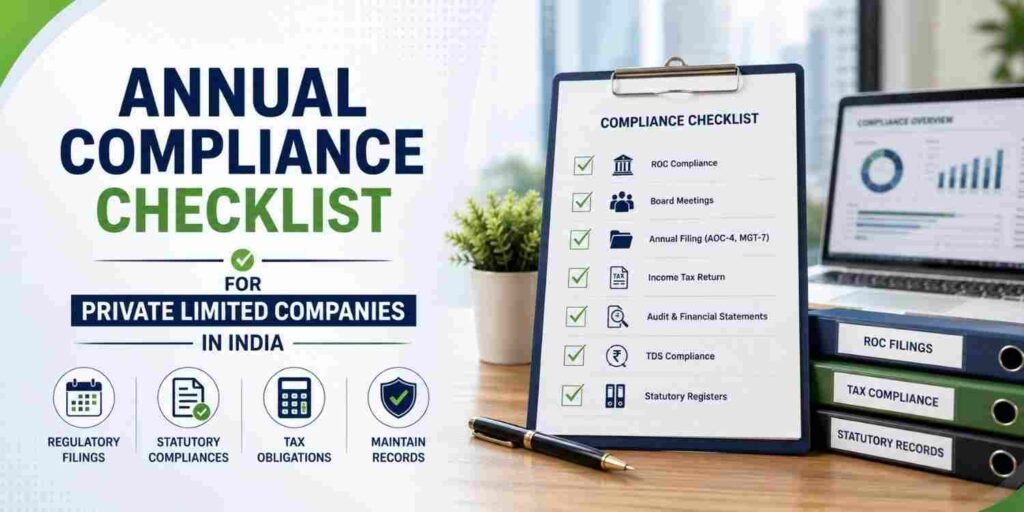
A typical private limited company compliance checklist includes maintaining statutory registers, conducting board meetings, preparing financial statements, holding the Annual General Meeting (AGM), filing the annual return, filing financial statements with the Registrar of Companies (ROC), completing applicable Director KYC, and meeting tax and GST obligations.
The exact list of compliances for a private limited company depends on factors such as business activity, turnover, registrations, transactions, and applicable exemptions.
Private Limited Company Compliance Checklist for 2026
A practical compliance checklist for a private limited company should cover both annual filings and regular corporate responsibilities. Here are the major items companies should review.
1. Maintain Statutory Registers and Corporate Records
The company should maintain the statutory registers and records required under the Companies Act, 2013. These may include records relating to members, directors, shareholding, charges, and other corporate matters, depending on the company’s circumstances.
Companies should also keep accounting records, minutes, resolutions, notices, and supporting documents properly organised.
Good records make compliance easier. Poor records make even a simple filing feel like an archaeological excavation.
2. Complete Board Meeting Compliance
Board meeting compliance is an important part of yearly compliance for a private limited company.
The Board of Directors must follow the applicable requirements for meetings, notices, agendas, attendance, minutes, and resolutions. Companies should document important decisions properly instead of relying on informal emails or verbal approvals.
The frequency and procedural requirements can vary depending on the company and applicable exemptions, so the Board should review its specific position under the Companies Act.
3. Prepare Financial Statements and Complete the Statutory Audit
Preparing accurate financial statements is central to statutory compliance for private limited company.
The company needs to prepare its financial statements for the financial year and complete the applicable statutory audit. The financial statements and supporting records should accurately reflect the company’s financial position and transactions.
These audited financial statements then support the company’s annual MCA filing and other applicable compliance requirements.
4. Hold the Annual General Meeting
AGM compliance is another key responsibility.
Under Section 96 of the Companies Act, 2013, every company other than a One Person Company must hold an AGM every year. Generally, an AGM other than the first AGM must be held within six months from the close of the financial year. The first AGM has a separate nine-month timeline from the close of the first financial year. The Act also generally requires that not more than 15 months pass between two AGMs.
The AGM allows shareholders to consider matters such as financial statements, the Board’s report, auditor-related matters, and other business placed before them.
5. File AOC-4 With the ROC
The AOC-4 filing is one of the most important parts of an annual filing for private limited company.
Under Section 137, the financial statements adopted at the AGM, along with the required documents, must generally be filed with the Registrar within 30 days of the AGM.
This means the AOC-4 due date is generally calculated from the AGM date rather than assuming one universal date for every company.
The filing typically covers the company’s financial statements and relevant supporting documents. Before submission, companies should ensure that the financial information and attachments are complete and consistent with the approved records.
6. Complete Annual Return Filing
Another important item in the private limited company annual compliance cycle is the annual return.
Section 92 requires a company to file its annual return with the Registrar within 60 days from the date of the AGM. Where an AGM is not held, the Act provides a separate calculation based on when the AGM should have been held.
Depending on the company’s eligibility, the applicable annual return form may include MGT-7 or the applicable abridged form.
Therefore, the MGT-7 due date should be calculated using the relevant AGM timeline rather than copied from a generic compliance calendar.
7. Complete Director KYC
Director KYC is another recurring MCA requirement.
Under the applicable DIR-3-KYC rules, an individual who has been allotted a DIN up to 31 March of a financial year is generally required to complete the KYC process by 30 September of the immediately following financial year.
Directors should therefore check their DIN status and ensure their required KYC information remains updated.
This is easy to overlook because it relates to the director rather than the company’s annual accounts, but it still belongs on the company’s compliance radar.
8. Review Auditor-Related Requirements
A company should also review its auditor appointment and related records as part of its legal compliance for a private limited company.
The Companies Act contains provisions relating to auditor appointment, eligibility, tenure, and related filings. Companies should check whether any appointment, reappointment, resignation, or other auditor-related event requires an MCA filing.
Tax and GST Compliance Are Also Part of the Picture
ROC filings are not the entire list of annual compliances for private limited company.
Depending on its activities and registrations, a company may also have income-tax, TDS, and GST responsibilities.
For example, the Income Tax Department’s current guidance for AY 2026-27 lists applicable return and audit requirements for domestic companies. For companies subject to tax audit, the applicable tax audit report and income-tax return deadlines should be checked against the current Income Tax Department guidance.
GST-registered companies must also review their applicable GST returns and annual return requirements. The GST Portal states that GSTR-9 is generally due on 31 December following the relevant financial year, unless the Government extends the deadline.
Therefore, complete compliance for a private limited company plan should bring MCA, income-tax, TDS, GST, and other applicable requirements together rather than tracking ROC filings alone.
Private Limited Company Compliance Calendar: A Simple View
The following table gives a practical overview of common requirements:
| Compliance | Form/Record | General Timeline |
| Statutory records | Registers, minutes, resolutions | Throughout the year |
| Board meetings | Notices and minutes | As applicable |
| Financial statements | Audited financial statements | Before applicable annual filings |
| AGM | AGM records and minutes | Generally within applicable Section 96 timeline |
| Financial statement filing | AOC-4 | Generally within 30 days of AGM |
| Annual return | MGT-7 / applicable form | Generally within 60 days of AGM |
| Director KYC | DIR-3-KYC / applicable process | Generally by 30 September for applicable DIN holders |
| GST annual return | GSTR-9, where applicable | Generally 31 December following the financial year |
| Income-tax compliance | Applicable ITR/forms | Depends on applicable provisions |
These are planning timelines, not a substitute for checking the latest government notification. A company’s exact requirements can change based on its facts and applicable law.
What Happens If a Company Misses Its Annual Compliance?
Delayed ROC compliance for private limited company can result in additional fees, penalties, and other consequences.
For example, Section 92 contains penalties relating to failure to file an annual return, while Section 137 provides consequences for failure to file financial statements. The Companies Act provides continuing penalties for certain defaults, so delaying a filing can become more expensive as the default continues.
Beyond the immediate financial impact, unresolved non-compliance can make future corporate actions, due diligence, financing, restructuring, or other business processes more complicated.
In short: compliance is cheaper when it is planned.
How to Manage Yearly Compliances for Private Limited Company
The simplest approach is to maintain a compliance calendar throughout the year rather than starting everything after the financial year ends.
Keep the following organized:
- Statutory registers
- Accounting records
- Board meeting documents
- AGM notices and minutes
- Audited financial statements
- MCA filing acknowledgements
- Tax returns and challans
- GST records, where applicable
- Director KYC records
- Auditor-related documents
Businesses considering Company registration services in Gurgaon should also think beyond incorporation. Company formation is the starting point; maintaining the company’s legal and financial records is what keeps the structure healthy.
For entrepreneurs planning Pvt Ltd Registration in Gurugram, setting up a proper compliance process from the beginning can make annual filings much easier. Uniqfiling can support businesses that want a structured approach to company formation and ongoing compliance rather than treating every deadline as a last-minute task.
Final Private Company Compliance Checklist
Before considering your annual compliance cycle complete, review whether you have:
- Updated applicable statutory registers and corporate records
- Completed required board meeting compliance
- Prepared financial statements
- Completed the applicable statutory audit
- Held the AGM within the applicable timeline
- Completed AOC-4 filing
- Completed MGT-7 or the applicable annual return filing
- Completed applicable Director KYC requirements
- Reviewed auditor-related compliance
- Completed applicable income-tax requirements
- Reviewed TDS compliance
- Reviewed GST returns and annual compliance, where applicable
- Stored filing acknowledgements and supporting documents
If you are comparing company registration services, choose a provider that can help you understand both incorporation and post-incorporation obligations. Uniqfiling can position compliance as an ongoing business process, not simply a form-filing exercise.
Final Thoughts on Private Limited Company Annual Compliance in 2026
The list of compliances for a private limited company may look extensive, but it becomes much easier when you break it into four areas: corporate records and meetings, financial reporting, MCA filings, and tax-related obligations.
The best strategy is simple: maintain records throughout the year, track deadlines early, and verify requirements against official government sources before filing.
Whether you already operate a private limited company or are planning to start one, a well-managed compliance system can protect your company’s records, reduce avoidable filing issues, and create a stronger foundation for growth.
Need professional help with your company compliance? Contact Uniqfiling today to get reliable, professional guidance for managing your company’s annual compliance requirements and staying on track with applicable filings.
FAQs About Compliances for Private Limited Company in India
Common compliances for private limited company include maintaining statutory records, holding required Board meetings and the AGM, preparing financial statements, completing the applicable audit, filing AOC-4 and the annual return, completing Director KYC, and meeting applicable tax and GST requirements.
The annual compliance for private limited company generally covers AGM-related requirements, financial statement filing, annual return filing, statutory records, Director KYC where applicable, and tax or GST obligations relevant to the business.
There is not one universal ROC filing due date. AOC-4 is generally due within 30 days of the AGM, while the annual return is generally due within 60 days of the AGM.
An ROC filing penalty depends on the particular default and applicable provision. Some Companies Act provisions impose continuing penalties for delayed filings, so companies should address defaults promptly rather than allowing them to accumulate.


